Showing posts with label Alliance Defending Freedom. Show all posts

Wednesday, July 6, 2022

Alliance Defending Freedom on the Southern Poverty Law Center: "Setting the Record Straight"

 * A video from Alliance Defending Freedom on the truth regarding the Southern Poverty Law Center.


The Truth About SPLC: Full from ADF Media Relations on Vimeo.

* For more information on ADF's perspective on the SPLC see HERE.

Thursday, February 28, 2019

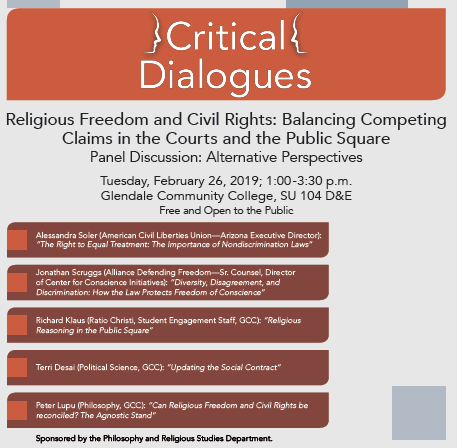
Religious Freedom and Civil Rights: Balancing Competing Claims in the Courts and the Public Square--Video

Glendale Community College's annual Critical Dialogues panel discussion held on February 26, 2019


Introductory Remarks: 10:30

Peter Lupu: 18:40-38:45

Alessandra Soler: 39:00-59:05

Jonathan Scruggs: 59:30-1:17:36

Terri Desai: 1:17:55-1:38:00

Richard Klaus: 1:38:20-1:55:35

Question & Answers: Starts at 1:55:40
-Richard asks Alessandra Soler a question: 1:58:30
-Question about businesses that have nothing to with religion making religious claims; Terri Desai brings up Hobby Lobby case: 2:14:10-2:21:40
-Richard's mom asks a question and Richard brings up the issue of wedding cake as a "manifestation" of religion: 2:21:40-2:27:00
-Peter speaks to the difficulty of issues; Terri Desai speaks of Framer's of Constitution as classical liberals who believed in progress; Richard speaks to the natural law tradition of the Framer's: 2:33:55-2:38:45
-Jonathan Scruggs speaks of difficult and easy cases as well as two distinctions (1) speech vs. conduct and (2) message vs. class of people; Peter's objection of the creation of more problems and Jonathan Scruggs answer that this may create more tolerance: 2:55:00 to the end. 

Monday, April 23, 2018

Courts and the Cause of Christ: Why Christians Need to Care

* This is a link to an essay I wrote for the Christian Post.

Courts and the Cause of Christ: Why Christians Need to Care
_______________________________________________

Here is the essay with the footnotes...


Courts and the Cause of Christ: Why Christians Need to Care

Sometime between now and June, the U.S. Supreme Court will render its decision in the Masterpiece Cakeshop case.  This is the case in which owner and cake artist Jack Phillips was taken to court because he could not in good conscience design custom items that celebrate events or express messages in conflict with his religious beliefs.  Jack Phillips is motivated by his Christian beliefs and is attempting to faithfully fulfill his deeply rooted religious beliefs.  He is seeking justice in the arena of law.

Another case—this one in Arizona—is Brush & Nib Studio v. City of Phoenix, in which Christian owners Joanna Duka and Breanna Koski are seeking to stop an overreaching city ordinance from forcing them to design and create custom artwork expressing messages that violate their core religious beliefs.  Without the invalidation of this city ordinance, Duka and Koski are potentially liable for fines and jail time if they decline to create artwork for same-sex weddings.  They too are seeking justice in the legal realm.

But why should Christians care about cases such as this?  Do cases like this take us away from the centrality of gospel proclamation?  Shouldn’t Jack Phillips, Joanna Duka, and Breanna Koski just lay down their rights in the face of opposition for the sake of being like Jesus, who “while being reviled, he did not revile in return; while suffering, he uttered no threats, but kept entrusting him to him who judges righteously” (1 Peter 2.23)?

I want to argue that the pursuit of justice is not only a good in and of itself but, also, that these legal cases can serve the cause of the gospel.

Christians in the Public Sphere

Christians who make use of the legal system to ensure that government respects their freedoms protected by the First Amendment do this out of a sense of obligation to honor God.  Their deeply held religious beliefs about God and the Bible move them to stand for truth in the public realm.  Their devotion to God and the Bible is not merely a private affair of the heart.  Christians believe the truth of Jesus and his kingdom morality are matters that touch all of life.  The most basic Christian confession, namely that “Jesus is Lord,” has implications for the public and political domain.  Theologian John Frame aptly notes:

As God’s Spirit penetrates people’s hearts through the gospel, those people become new creatures (2 Cor. 5:17).  They take their faith into every sphere of life, including the workplace, politics, economics, education, and the arts.  And in all these realms, they seek to glorify God.[1]

In his essay “Why Christians Should Influence Government for Good,” Wayne Grudem lists a number of reasons why Christians can and should be involved in the political and judicial realm.[2]  His list includes the following:

1.     God calls Christians to do “good works.”
2.     Influencing government for good is a way to love our neighbors.
3.     Obeying what God tells us is doing spiritual good because it glorifies God.
4.     Good and bad governments make a huge difference in people’s lives, and in the church.
5.     Christians have influenced governments positively throughout history.

I will leave it to readers to read Grudem’s full discussion of these points, but he details the many biblical examples in both the Old and New Testaments where believers have exercised significant governmental influence.  Examples include Joseph, Moses, Daniel, Nehemiah, Esther, the prophets, John the Baptist, and Paul.

These insights from Frame and Grudem are enough to justify the Christian’s concern and involvement in the political and judicial arenas.  In addition to this, however, there is the example of the apostle Paul in the book of Acts that shows how a proper use of legal redress actually serves the gospel and the mission of the Church.

Paul’s Use of the Courts in the Book of Acts

The book of Acts is filled with legal settings, and nearly a quarter of the book is occupied with Paul’s trials and defenses.[3]  In particular, a section from Acts 16 will illustrate something of Paul’s interface with the Roman legal system and allow us to draw some applications for our time.

That chapter contains the narrative of Paul’s ministry in Philippi.  As is often the case in the book of Acts, Paul’s ministry causes controversy.  The specific cause in Philippi is the exorcism of a slave-girl being pimped for prophetic profit.  Paul casts out a “spirit of divination” from the girl, and when the men using this girl for financial gain see their potential for making money diminished, they bring Paul and Silas before the Roman governmental authorities.  The judgment is swift.  They are beaten with rods and thrown into prison.  There are then some exciting details about an earthquake that opens the prison doors and how the jailer and his family come to faith in Jesus Christ.  For our purposes, however, the focus is on verses 35-40:

35Now when the day came, the chief magistrates sent their policemen, saying, “Release those men.” 36And the jailer reported these words to Paul, saying, “The chief magistrates have sent to release you. Therefore come out now and go in peace.” 37But Paul said to them, “They have beaten us in public without trial, men who are Romans, and have thrown us into prison; and now are they sending us away secretly? No indeed! But let them come themselves and bring us out.” 38The policemen reported these words to the chief magistrates.  They were afraid when they heard that they were Romans, 39and they came and appealed to them, and when they had brought them out, they kept begging them to leave the city. 40They went out of the prison and entered the house of Lydia, and when they saw the brethren, they encouraged them and departed.

We could ask a number of potential questions about this event.  When given the information of release, why did Paul not simply leave?  Paul knew from Jesus that he was called to suffer (Acts 9.16).  Why not just receive the suffering and go forward?  When other apostles were unjustly persecuted, they left their accusers “rejoicing that they had been considered worthy to suffer shame for his name” (Acts 5.41).  Why didn’t Paul do this?  Why protest and demand legal redress in light of his Roman pedigree?

A couple of answers are worth noting.  Paul is concerned for justice and the people of God.  First, consider the issue of justice.  Paul knows the Roman law code and appeals to its provisions, which forbid a magistrate from beating a Roman citizen without due process of a trial conviction.  No one is claiming the Roman law code is a perfect manifestation of justice, but Paul can appeal to a common grace provision in that law code which is consistent with justice.  Although Paul is called to a path of suffering as announced by Jesus, there is no divine mandate to maximize suffering.  As theologian Steven Tracy notes,

Scripture does not sanctify avoidable suffering.  Christ repeatedly avoided physical assault, most often from the Jewish leaders (his authorities) by hiding (John 8:59), by maintaining physical separation from his abusers (Matt. 12:14-15; John 11:53-54), and by eluding them (John 10:31, 39).  Other godly individuals in Scripture, such as Paul and David, also repeatedly fled physically abusive authorities (1 Sam. 19:12; 27:1; Acts 9:22-25; 14:5-6; 17:8-10, 14).  Jesus did not teach his disciples simply to accept abuse (evil); instead he taught them to pray that God would deliver them from it (Matt. 6:13).[4]

At this point, someone may ask why Paul did not assert his Roman citizenship rights earlier—before being beaten with rods?  One can only speculate given the silence of the text, but it is possible that he and Silas did assert their citizenship but were drown out in the confusion of the event.[5]  Whatever the explanation on that issue, it is clear that Paul does eventually assert his Roman citizenship by appealing to Roman law for justice.

But there is more.  This is not a mere quest for personal justice.  There is also a strategic concern for the gospel ministry which has birthed the fledging church in Philippi.  To allow this injustice to stand might mean the civil magistrate would be emboldened to perpetuate further injustices upon the newly formed group associated with Paul and Silas.  By seeking proper legal redress, Paul and Silas provide protective covering for the church.  New Testament scholar F. F. Bruce comments:

Paul’s insistence on an official apology may have served to some degree as a protection to the members of the church which had been planted in Philippe during the period of his stay there.[6]

Fellow New Testament specialist I. Howard Marshall also recognizes that for Paul and Silas to simply have left without seeking justice “could have set a dangerous precedent for the future treatment of missionaries and also could have left the Christians in Philippi exposed to arbitrary treatment from the magistrates.”[7]  So, in this instance, seeking justice is good for the missional advance of the gospel.

Understanding the Text and the Times

Paul’s example in Acts 16 is only one case from the New Testament, but it is a perspective to take note of since it demonstrates concern for public justice and the gospel.  The interplay between moral mandate and contemporary application is always tricky.  Even within the New Testament itself, there is a spectrum of responses to the civil government.  Torleiv Austad, in his essay, “AttitudesTowards the State in Western Theological Thinking,” argues that the New Testament’s perspective regarding the state was neither principled renunciation nor uncritical acceptance.  He writes,

The apparently contradictory attitude can be illustrated by comparing Romans 13 and Revelation 13.  In both cases Christians are confronted with the Roman state.  While the governing authorities according to Romans 13 respect elementary civil rights, the same state in Revelation 13—about forty years later—is seen as the beast from the abyss.  Therefore the attitude of Christians has changed from obedience to disobedience.  Within the eschatological horizon of the NT the relationship between Christians and the governing authorities is never fixed; it is complex, sensitive and changing.[8]

In this quotation, Austad stresses the believer’s response of either obedience or disobedience to the governing authorities.  His general line of thinking can be expanded to include the kinds of responses the governing authorities have to the believer’s concerns.  It may be the case that an ever-increasing secularized civil sphere is becoming less concerned with Christians’ concerns for justice, but this ought not to stop Christians from appealing to those common grace notions embedded in our legal traditions.  This is what Paul did in his Roman context.  Similarly, when Christians today in the United States seek legal remedy for the diminishment of their constitutionally protected freedoms, it can serve the cause of justice and the gospel. 

The constitutionally governed law codes that Americans navigate at the local and federal levels are seasoned with common grace elements of justice.  As long as possible, we ought to utilize these elements in the cause of justice and the gospel.

Christians should eagerly support and pray for the efforts of Jack Phillips, Joanna Duka, Breanna Koski, and others like them as they seek justice before the courts of our land.  Much like the apostle Paul, their victories will continue to hold open the door of religious freedom for all of us.


     [1] John Frame, “In Defense of Christian Activism vs Michael Horton and Meredith Kline” (May 21, 2012) online: https://frame-poythress.org/in-defense-of-christian-activism-vs-michael-horton-and-meredith-kline/.
     [2] Wayne Grudem, “Why Christians Should Influence Government for Good” online: http://www.waynegrudem.com/wp-content/uploads/2014/05/Why-Christians-should-influence-government-booklet.pdf.
     [3] “One of the puzzling features of Acts is the amount of time Luke spends describing in detail the trial and defenses of Paul.  Almost one-fourth of the whole book of Acts (chaps. 22-28) is occupied with this topic.”  D. A. Carson and Douglas Moo, An Introduction to the New Testament—2nd ed. (Grand Rapids, Mich.: Zondervan, 2005), 303.  “Acts is a book of trials.  Sixteen formal and informal, investigative and quasi-judicial trials occur.” John W. Mauck, Paul on Trial: The Book of Acts as a Defense of Christianity (Nashville, Tenn.: Thomas Nelson, 2001), 84—see page 85-86 for chart of all the trials in Acts.
     [4] Steven Tracy, “Domestic Violence in the Church and Redemptive Suffering in 1 Peter” Calvin Theological Journal 41 (2006), 294.  Online: https://mendingthesoul.org/wp-content/uploads/DV-in-Church-1-Peter.pdf.
     [5] John Mauck also notes the context of bigotry in the charges mentioned in verses 20-21: “The accusation of being Jewish is intended to inflame the Philippian magistrates through appeal to racism, anti-Semitism, or fear of foreigners.” Paul on Trial: The Book of Acts as a Defense of Christianity (Nashville, Tenn.: Thomas Nelson, 2001), 125.
     [6] F. F. Bruce, Commentary on the Book of the Acts (Grand Rapids, Mich.: Eerdmans, 1954), 341.
     [7] I. Howard Marshall, The Acts of the Apostles: An Introduction and Commentary (Grand Rapids, Mich.: Eerdmans; Leicester: Intervarsity Press, 1980), 274.
     [8] Torleiv Austad, “Attitudes Towards the State in Western Theological Thinking,” Themelios (October, 1990), 22.

Thursday, October 1, 2015

New Forensic Report on Planned Parenthood Videos

Alliance Defending Freedom (ADF) has released a forensic report on the Planned Parenthood videos that have been taken by the Center for Medical Progress (CMP).  The ADF blog has a post entitled New Forensic Report Flushes Planned Parenthood's "Highly Edited" Talking Point which describes the summary details of a forensic analysis done by Coalfire--a company that specializes in digital forensic analysis.  Here are a few excerpts from the ADF blog post:
 But yesterday ADF released the results of a new forensic report that debunks this talking point. Coalfire, one of the country’s most trusted digital forensic analysis companies, released a report indicating the undercover videos recorded by the Center for Medical Progress are “authentic and show no evidence of manipulation.” 
Forensic analysts were granted access to all of the raw investigated footage recorded by the Center for Medical Progress and checked it against the full length videos posted on the CMP YouTube account. They found the only events not depicted in the publicly available videos fell into five common categories: commuting, waiting, adjusting recording equipment, meals, and restroom breaks. All of the edited content was “non-pertinent” to the actual investigation.
Later the post states:
Even Planned Parenthood’s own paid for “analysis” confirms that there is “no evidence of audio manipulation” and that it did not reveal “widespread evidence of substantive video manipulation.” But Planned Parenthood and its media allies have ignored this fact, focusing instead on their suspicion of the missing parts of the full videos available on YouTube. And now we have confirmation of just how ridiculous this fixation has been.
Be sure to read the full blog post by ADF.  The full report from Coalfire is linked to from the ADF blog post as well.

Saturday, October 18, 2014

Houston Sermons Subpoenaed: Russell Moore on "Why Not Hand Them Over?"

Russell Moore asks and answers the question Why Not Just Hand the Sermons Over? as he discusses the recent events in Houston, Texas.  His answer is short but covers a great deal of ground in answering basic types of objections.  Here are few items from the blog post:
These questions come really in two or three different forms. The first is based on Romans 13, the Apostle Paul’s teaching that the government has God-given authority. We submit to government, the argument goes, even when we don’t agree with specific government policies. So why not just send in the subpoenaed sermons, even if we don’t like it, since we have nothing to hide.
The problem with this view is that Romans 13 is not an unlimited authority. Paul clearly bounds in the power of Caesar’s sword to the punishing of “wrongdoers” (Rom. 13:4). That’s why the Apostle says that taxes are to be paid, along with honor and respect, to those to whom such things are due (Rom. 13:7). On the opposite side of the spectrum from Romans 13 is Revelation 13, which demonstrates what happens when a government oversteps its bounds, as was the case eventually in the Roman Empire’s attempt to regulate worship.
Every authority, under God, is limited. Daniel is obedient to King Nebuchadnezzar, until the king decreed the way prayers should be offered. Peter and John are obedient to the authorities, until they are told how to preach, in which case they defy this authority (Acts 4:19-20).
Moreover, the issue is even clearer when we recognize that the City of Houston, and beyond that the broader American governing system, is, unlike in the case of Caesar, not the rule of one man (or one woman). There were all sorts of governing officials up and down the chain in the Roman Empire, but the ultimate accountability was Caesar himself. In our system of government, the ultimate “king” is the people. As citizens, we bear responsibility for electing officials, for speaking to laws that are made in our name, and for setting precedents by our actions. Shrugging this off is not the equivalent of Jesus standing silently before Pilate. It’s the equivalent of Pilate washing his hands, so as not to bear accountability for our own decisions and precedents set.
When the government acts, legal precedents are set. By complying with this unjust decree, Christians would be binding future people and institutions, including those who are the most powerless to stand against such things. If the government can scrutinize the preaching of Christian churches on sexual matters in Houston, the same government could do the reverse in, say, Amarillo. It would be just as wrong for the mayor to demand to see sermons from the Episcopal Church calling for LGBT anti-discrimination laws as it is to do this. As citizens, we bear responsibility. This is analogous to the tax collectors and soldiers coming to John and to Jesus asking how they are to function as Christians in the world of Caesar. They were not to use their power to defraud people or to go beyond their delegated authority (Lk. 312-14; 19:8).
It sounds spiritual and pious to say that we are just going to “give up our rights” and “surrender our place at the table.” We should indeed do that. When we are stricken on the cheek, we turn the other one. When someone takes our tunic, we give up our cloak as well (Matt. 5:40-41). That’s quite different though from those who have been given police authority ignoring assaults; such is injustice decried by Scripture. And it’s quite different from a soldier forcibly collecting cloaks because “you ought to be giving those up anyway.”
That’s why the Apostle Paul, quite eager to give up his personal rights (1 Cor. 11:7-11), appealed to his Roman citizenship repeatedly in the Book of Acts, litigating for liberty. And that’s why he, like John and Peter, refused to comply with a decree that was unjust (Acts 16:35-39).
Be sure to read the rest of the post and see Moore's answer to the following question:
But, some would ask, aren’t these sermons public anyway? Why would we not want the mayor and the city attorney to hear them?

Thursday, November 7, 2013

"Marriage & Society: The Big Picture"--ADF's New Video

Here is a new video from Alliance Defending Freedom which argues for the importance of marriage and why government should take a stand on this issue.


Friday, February 8, 2013

ADF Video on Defending Marriage

This new video, put out by the Alliance Defending Freedom, is wonderfully done.  It briefly, but poignantly, articulates why the Defense of Marriage Act (DOMA) is good and ought to be preserved.


Monday, December 3, 2012

Boko Haram as a Terrorist Organization

Our church distributes a prayer calendar for the persecuted church worldwide every month.  Often the nation of Nigeria is on it with a special mention of the Islamic terrorist group Boko Haram and its attacks on Christians.  Now Alliance Defending Freedom is petitioning the U. S. Government to officially designate Boko Haram as a terrorist organization.  In a news release ADF states:
Alliance Defending Freedom and Jubilee Campaign, together with several other concerned organizations, are formally requesting that the U.S. State Department designate the Nigerian jihadist group Boko Haram as a “foreign terrorist organization.” Boko Haram is responsible for killing an estimated 3,000 Nigerians and citizens of 11 other countries—primarily Christians—in the last three years and has acknowledged it has ties to Somalian terrorist groups and Al Qaeda. The prosecutor at the International Criminal Court in The Hague recently found probable cause that the group committed crimes against humanity.
The reason that such a declaration is important is stated in the news release:
The Anti-Terrorism and Effective Death Penalty Act of 1996 empowers the State Department to designate such groups as “foreign terrorist organizations.” Such a designation would have numerous effects, including the ability to freeze and seize bank accounts, arrest and deport Boko Haram members and associates, and impose sanctions on countries that fund the terrorist group.
 For those interested they can read the official 66 page petition HERE.

EVERYONE CAN BE INVOLVED IN PETITIONING THE U. S. GOVERNMENT BY GOING TO THE OFFICIAL WHITE HOUSE WEBSITE AND SIGNING THE PETITION THERE!

The White House website petition needs 25,000 signatures to trigger a needed official response.  Please consider being a part of this petition for our brothers and sisters in Christ who reside in Nigeria.
__________________________________________________

UPDATE (12/4): I just received this from Christian Aid and it gives more of the context of what Boko Haram does:
NIGERIA: Terror Increases Daily in Africa's Most Influential Nation

By Rae Burnett

Some of last week's Boko Haram terrorist headlines: twenty female university students slaughtered in the middle of the night; Christian family of three burned to death in their home; ten Christians murdered and homes destroyed by fire; three churches torched; three police stations bombed, one to release the terrorists who had been captured and imprisoned....on and on. This well-funded Muslim terrorist group whose name means they are against Western education is striking fear throughout the nation with the purpose of forcing enactment and strict enforcement of Islamic sharia law.

Attacks are increasing and now occur almost daily with nothing to deter them. Nigeria is sub-Saharan Africa's most populous and influential country. An Islamic Nigeria would have a profound impact on the entire continent.

Thursday, August 2, 2012

Jeffrey Ventrella: "Living in Sin...Well."

Recently our church concluded our summer series entitled "Christianity and Contemporary Challenges."  We had four lectures:
1.  James White "Islam: What Every Christian Needs to Know"
2.  Richard Klaus "The Historical Adam: Biblical Reality and Current Challenges"
3.  Wayne Grudem "Why and How Christians Should Seek to Influence Government for Good"
4.  Jeffrey Ventrella "Living in Sin...Well: Faithful Living in Babylon" 
I wanted to draw particular attention to Dr. Ventrella's presentation.  (Audio and lecture notes are HERE)  He is a phenomenal speaker and I found him challenging, insightful, convicting and faith building.  Dr. Ventrella, as a Senior Vice President with Alliance Defending Freedom, is uniquely situated to speak to the cultural issues of our day and how Christians should respond.  Dr. Ventrella spoke from Jeremiah and applied the insights of this prophetic book to our time.  In this he reminded me of Francis Schaeffer who did something similar in his 1968 lectures which became the book Death in the City.  We live in a time of cultural decline but this is not the first time that God's people have faced this kind of crisis.  Drawing from Jeremiah 29 Dr. Ventrella shows how God's people are to respond in this kind of cultural captivity.

One of the points that I found helpful came out in the question/answer period.  I mentioned that I had recently read the essay What Is Marriage? by Sherif Girgis, Robert P. George, and Ryan T. Anderson published in the Harvard Journal of Law and Public Policy.  This is an attempt to provide a non-religious argument for traditional marriage.  It is an example of natural law reasoning.  My question revolved around the propriety of this kind of argumentation.  In his response, Dr. Ventrella mentioned the example of Daniel refusing to defile himself with the king's food (Daniel chapter one).  The argument Daniel makes is a prudential argument:
Please test your servants for ten days, and let us be given some vegetables to eat and water to drink.  Then let our appearance be observed in your presence and the appearance of the youths who are eating the king's choice food; and deal with your servants according to what you see.  Daniel 1.12-13
This is a not a "we must obey God; not man" argument.  Rather, it is an appeal to pragmatic issues.  There are times when these types of arguments can be used and used effectively.  This is not deny that explicit Scriptural arguments ought to be used.  And at times we should speak of our fundamental religious commitments as constraining our obedience--this happens in Daniel chapter three when Shadrach, Meshach, and Abed-nego simply refuse to bow before the golden image of Nebuchadnezzar.  Here there is no prudential reasoning.  There is just flat out obedience to God and disobedience to the king's decree.  Of course, wisdom is needed in understanding the contexts in which the various kinds of reasoning can and should be used.

For more from Jeffery Ventrella be sure to see "Square Circles?!! Restoring Rationality to the Same-Sex 'Marriage' Debate".

Also, I began watching a debate Dr. Ventrella had with professor Mary Anne Case on the issue of same-sex marriage.  That video can be accessed HERE.